What are AI Agents and why is MCP so incredibly powerful
Read the original here (published by me): What are AI Agents and why is MCP so incredibly powerful
AI Agents and MCP (Model Context Protocol)
AI Agents is a term that is so openly used nowadays that whenever it is used, it can mean very different things depending on who you speak to.
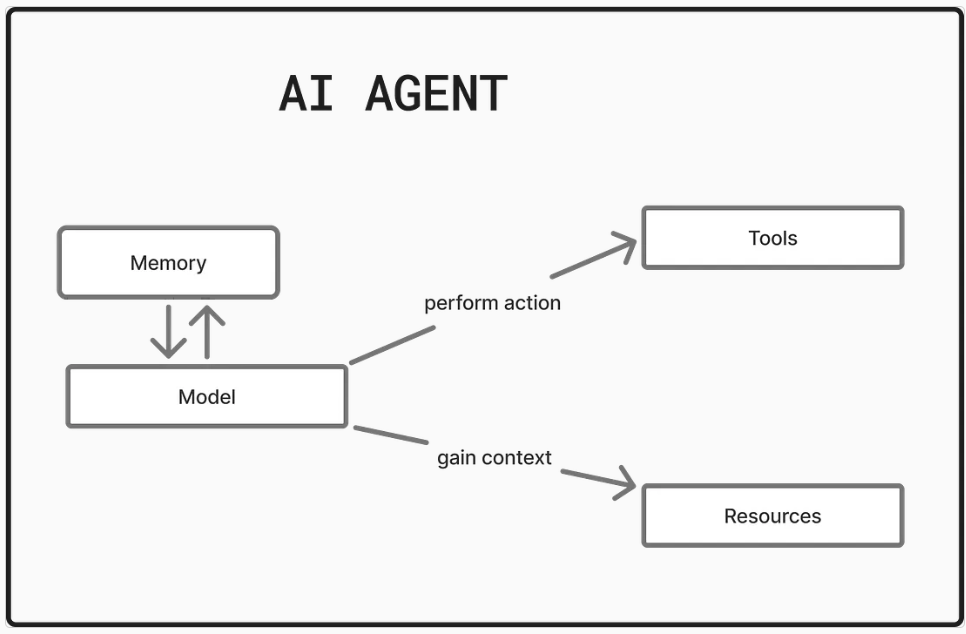
At the core, An AI Agent is just an LLM (Model) that has access to:
- Tools (to perform actions),
- Resources (for additional context), and
- Memory
But it’s not necessary that all of these must be present. An AI Agent can also be just LLM + tools.
So, what is an AI Agent?
An LLM that can reason over input, use context, and take actions via tools.
AI Agents can handle tasks as simple as performing basic math operations to tasks as complex as those performed by humans. An AI Agent by itself can also be just a very simple tool.
Some examples of AI Agents
Calculator Agent
Purpose:
Based on user query, performs math operations and returns a result.
Coding Agent
Purpose:
Assists developers by generating, reviewing, and modifying code, and can interact with tools like terminals, documentation, or test runners to perform actions.
Research Agent
Purpose:
Gathers, analyzes, and summarizes information from various sources (e.g., web, papers, databases) to provide reliable, context-rich answers to user queries.
While these agents don’t seem interesting or powerful on their own, imagine a system where the output of one agent becomes the input to another, with an agent overseeing all of them. This gives us unlimited ways to use our imagination.
This is what the world is trying to do now: building complex agentic workflows and multi-agent orchestrators.
So, when someone speaks about AI Agents, it can mean:
- A complex Agentic AI system where many agents perform complex operations using tools, or
- Something as simple as a calculator agent with calculation tools.
What is MCP (Model Context Protocol)?
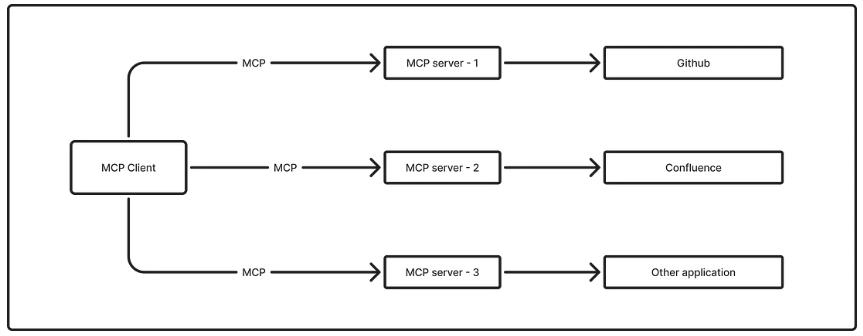
The MCP is an open, standardized protocol (originally developed by Anthropic and now widely adopted) that enables LLM-based agents (MCP clients) to discover and invoke external tools, services, and data sources through a uniform interface, essentially acting as a universal connector between agents and capabilities.
An MCP server can expose tools, resources, or prompts.
An MCP client can connect to an MCP server using transports such as stdio or streamable HTTP.
General Flow
- Client connects to MCP server and establishes the protocol session.
- Client calls
listToolsto discover available tools. - Server responds with a list of all exposed tools.
- Client selects a tool and invokes it with
callToolalong with inputs. - Server executes the tool and returns the result.
- Client can repeat tool/resource calls or close the session when done.
An MCP client can invoke requests such as listTools or listResources in a standardized way. You will call listTools in the same way whether you are connected to a Confluence MCP server, a GitHub MCP server, or any other MCP server. The MCP client can also invoke the tools from the discovered list.
Why is MCP so powerful and why is everyone adopting it?
Press enter or click to view image in full size
Using MCP, any system can either provide its capabilities to another system or use another system’s capabilities through a common, standardized protocol.
Without MCP, every time you want to interact with a new system like GitHub, Confluence, or any other application, you must build a custom client that understands its unique specifications. You have to start from scratch, learning each system’s specifications whenever there is a need to integrate with a new application.
Conclusion
In this article, we saw:
- What an AI Agent is
- What the MCP protocol is
- Why MCP is being widely adopted by companies around the world
As AI agents continue to evolve, MCP will serve as the backbone that allows them to connect and collaborate seamlessly with external systems.
Thanks for reading, and give a clap if it was worth your time.